By Keystone School
Twenty-five years after the September 11 attacks, the event occupies an unusual place in the curriculum. For students in school today, it is history — something that happened before they were born, documented in textbooks and documentaries. For most of their teachers and all of their parents, it is something else: a day they remember in specific, personal detail.
That gap between lived memory and historical study creates both a challenge and an opportunity for schools. How do you teach an event that is simultaneously recent enough to feel raw and distant enough to require historical framing? How do you make it meaningful for a twelve-year-old who has grown up entirely in a world shaped by it?
At Keystone, the answer this year was to approach it differently at every level.
The Little School: Learning About Heroes
For the youngest students at Keystone, the September 11 anniversary was approached through the lens of community helpers and heroes. Students wore red, white, and blue, said the Pledge of Allegiance, and had conversations about respect for their country and the people who work to keep communities safe — firefighters, police officers, doctors, and members of the military.
The class gathered in front of the school as teachers lowered the flags. It was a quiet, age-appropriate moment of acknowledgment — one that introduced the idea of national significance without requiring young children to process the specifics of the attacks themselves.
Seventh Grade: History, Empathy, and Origami
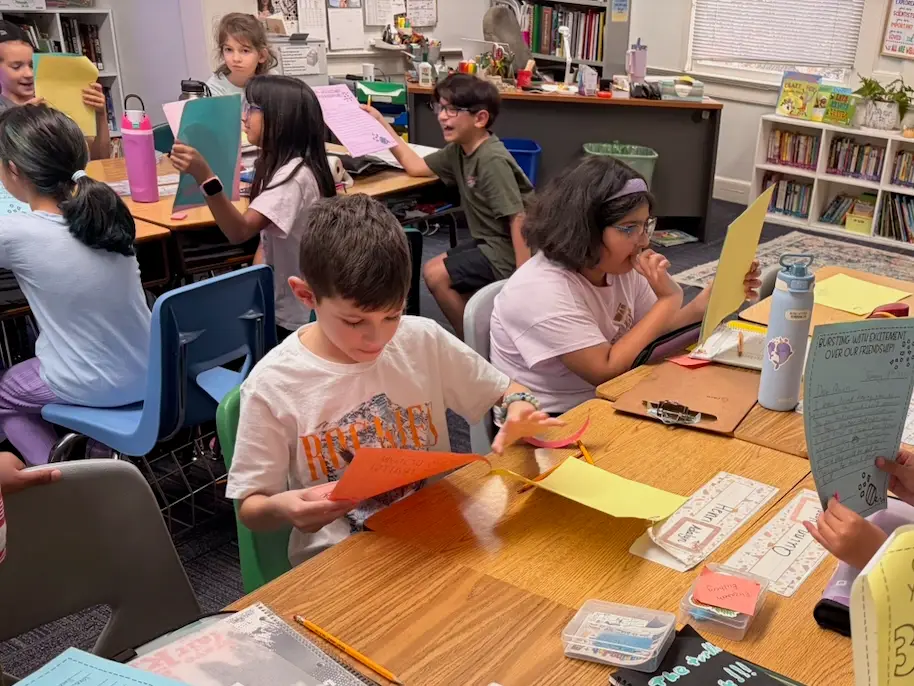
In Dr. Rivas’ 7th grade U.S. History and Civics class, students approached the anniversary through a structured learning activity. They began by noting what they already knew, what they wanted to know, and what they were still uncertain about. They watched a short documentary, discussed what they’d seen, and then made origami cranes — a symbol of peace and healing drawn from Japanese tradition — before completing a written reflection.
The combination of analytical activity, visual documentary, discussion, and a hands-on creative element reflects something important about how the Harkness-influenced classrooms at Keystone work. Students don’t receive information passively. They process it in multiple ways, which deepens both understanding and retention.
For seventh graders, the origami crane offered something the worksheet couldn’t: a physical, tactile way to engage with the idea of grief and healing. It’s a small detail, but it’s the kind of pedagogical choice that distinguishes thoughtful teaching from simply covering the material.
Political Science: The Hard Constitutional Questions
In Ms. Pittman’s Political Science class, the conversation moved into more demanding territory. Students took on one of the central questions raised by September 11 and its aftermath: how should a democracy balance justice, security, and constitutional principles when facing an extraordinary threat?
That question doesn’t have a clean answer, which is precisely why it’s worth asking in a high school classroom. Students who can engage seriously with that kind of tension — who can hold competing values in mind, articulate the strongest case for each, and reason toward a position without pretending the question is simple — are developing exactly the kind of thinking that selective universities and demanding careers require.
AP Psychology: What Happened to the American Mind
In the same teacher’s AP Psychology class, students approached the day from a different angle entirely. Rather than examining the political or historical dimensions of September 11, they asked a psychological question: how would you study what happened to Americans psychologically on that day?
The question pushed students to think methodologically — to consider what evidence you would need, how you would gather it, what the limitations of different research approaches would be, and how you could draw meaningful conclusions about mass psychological experience from available data. It’s the kind of question that makes psychology feel like a real discipline rather than a collection of concepts to memorize.
Why Cross-Disciplinary Teaching of Difficult History Matters
The Keystone approach to September 11 — adapted by age and subject, reaching from a kindergarten flag-lowering to a high school psychology methodology discussion — reflects a broader principle about how difficult history should be taught.
Students who encounter a significant historical event only in one class, through one lens, tend to develop a partial understanding of it. They learn the facts, or the political context, or the emotional resonance, but rarely all of these together. When the same event is approached from multiple disciplines — history, political science, psychology, civic education — students develop a more complete and more durable understanding. They also begin to see how different fields of inquiry illuminate different aspects of the same reality, which is one of the most valuable things a school education can teach.
For families thinking about what a genuinely rigorous education looks like, the September 11 curriculum at Keystone is a useful example. It’s not a single lesson. It’s a whole school engaging with something important, each division and classroom bringing its own tools to the same question.
If you’d like to learn more about Keystone’s approach to academics across grade levels, we’d love to have you come visit campus and see it in person.